What is Asset Management?
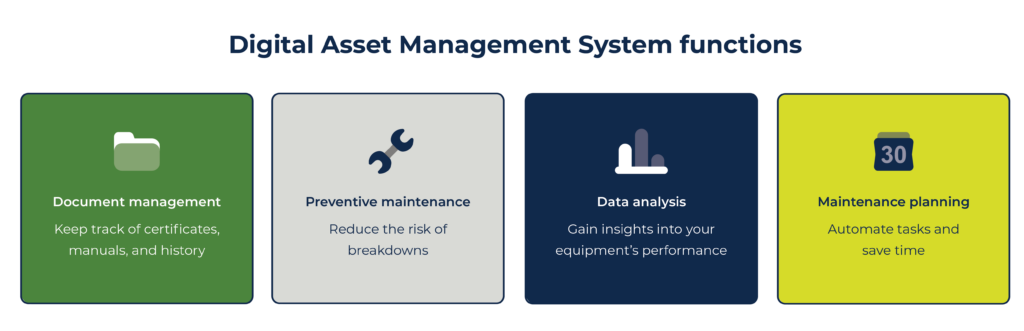
Asset Management allows you to efficiently track, manage, and maintain your equipment, machinery, and other assets. An Asset Management System includes features such as:
- Document management: Keep track of certificates, manuals, and maintenance history.
- Preventive maintenance: Reduce the risk of unexpected downtime and breakdowns.
- Data analysis: Gain insights into your equipment’s performance and lifespan.
- Maintenance planning: Automate tasks and save time.
By implementing an Asset Management System, your company can streamline operations, reduce costs, and optimize maintenance routines. Choosing a cloud-based maintenance system like INEXTIA gives you easy access to all your asset information – anytime, anywhere.
Implementing an Asset Management System
When implementing an Asset Management System, having a clear plan is essential. A maintenance system can increase efficiency and reduce costs, but to get the most value from your solution, you need to consider your company’s specific needs.
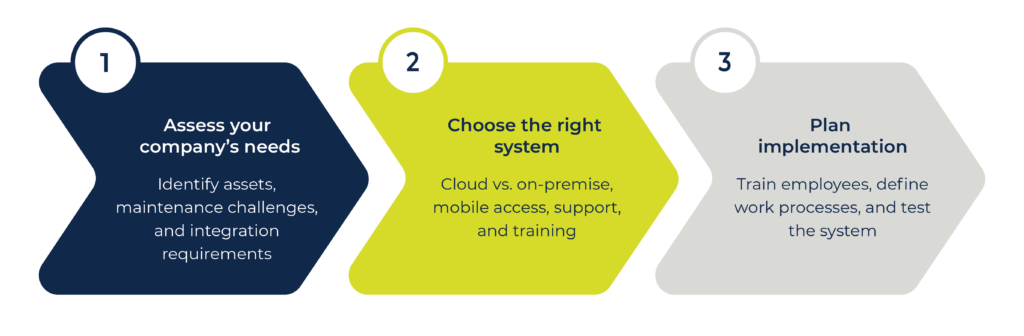
Start by assessing your business needs
Before choosing a system, analyze your company’s requirements:
- What types of assets do you manage?
- Do you have specific maintenance challenges?
- Does the system need to integrate with other software?
A thorough self-assessment helps ensure you select the right system from the start. It is not just about identifying your assets but also understanding how to maintain them effectively.
Choose the right Asset Management System
Asset Management Systems vary in scope – some are designed for small businesses, while others cater to complex needs in large organizations. Consider if:
- The system should be cloud-based or installed on-premise?
- Your company requires mobile access via an app?
- The provider offers support, training, and consulting?
Take the time to evaluate different systems and select one that fits your company’s size, structure, and maintenance needs.
Plan implementation step by step
Think of implementation as a construction process, you start with the foundation and build upwards. Develop a careful plan that outlines each step of the system rollout within your organization. Ensure that work processes are clearly defined and that employees receive the necessary training. Consider all possible scenarios and be prepared with solutions.
Once the system is live, closely monitor how it performs in practice. Regularly gather user feedback and be ready to make the necessary adjustments.
Digital Asset Management System: What are the benefits of digitalization?
By digitalizing Asset Management, you can achieve an unprecedented level of precision, efficiency, and insight. With real-time asset tracking and data analysis, you gain better decision-making capabilities and optimize resource utilization.
Digitalization reduces human error and provides a more reliable foundation for maintenance planning and forecasting. This not only enhances daily operations but also contributes to a more sustainable future by extending asset lifespans and reducing waste.
Benefits of a Digital Asset Management System:
- Efficient tracking: An Asset Management app allows you to easily track the location of your assets and equipment, eliminating wasted time.
- Preventive maintenance: Plan regular maintenance in line with equipment needs, reducing the risk of unexpected failures.
- Optimizes inventory management: A digital Asset Management system enables more precise control over spare parts and consumables, helping to cut costs.
- Data analysis: Collect and analyze asset data to gain valuable insights into lifespan and performance.
Digitizing Asset Management simply makes your workday easier. With all asset information readily available on a digital platform, you can:
- Reduce paperwork and manual processes
- Share information quickly and easily with your team
- Improve communication between department
- Streamline decision-making
| Funktion | Digital Asset Management System | Filserver |
|---|---|---|
| Automatisering | ||
| Forebyggende Vedligehold | ||
| Dataanalyse | ||
| Mobil Adgang | ||
| Dokumentstyring |
Document management plays an essential role in Asset Management
In a work environment where the volume of data and documentation is growing exponentially, it is essential to have a system that not only stores information but also intelligently organizes and makes documents easily accessible.
Keep track of important documents such as maintenance logs, warranties, user manuals, and regulatory compliance records. A well-structured system ensures that relevant information is available to the right people when they need it, increasing efficiency and minimizing the risk of errors.
Additionally, a robust document management system supports compliance with various legal requirements and standards, which is crucial in many industries. Ultimately, integrating document management into Asset Management enables a more streamlined, transparent, and accountable approach to asset oversight.
Get your job list in an Asset Management App
In addition to organizing documents, you can also manage maintenance tasks on the go with an app. Whether you are online or offline, you can easily create and complete tasks, find important documents, log work hours, and enter meter readings.