The utilities industry is focused on improving overall cost efficiency. Reducing operating costs and better utilization of fixed assets increases value creation – this can be achieved with a focus on operations and maintenance.
Optimization of maintenance on utility facilities
INEXTIA organizes the maintenance of your facilities to reduce downtime and avoid shutdowns. The utility industry has very specific needs when it comes to maximizing yield and avoiding shutdowns – or in the worst case, accidents.
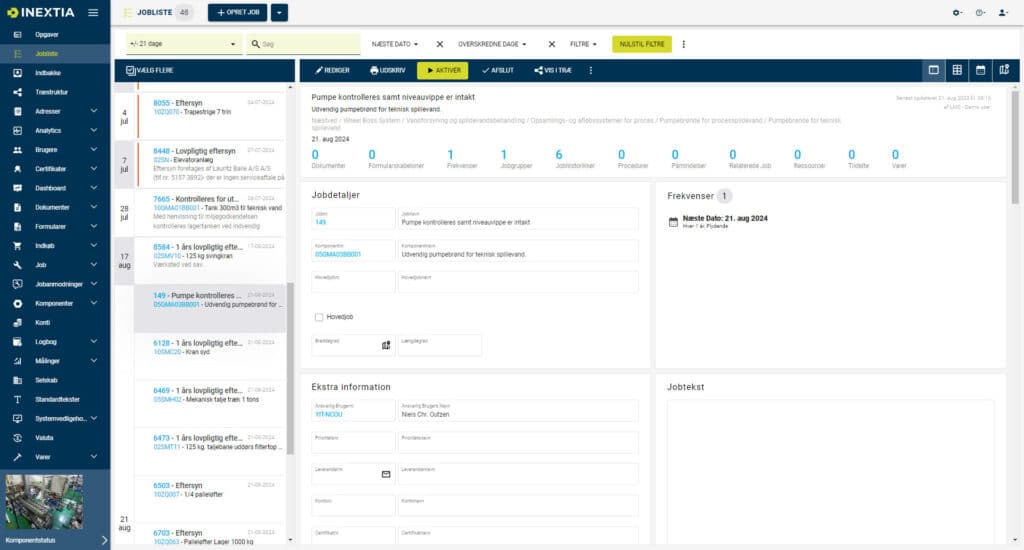
With a maintenance system, important information is gathered in one unified solution, which makes it easy to create an overview of activities across the plants.
Maintenance structuring
Data collection and history
Hour counting from SRO
GPS coordinates on wells and plants
Available job list via mobile
Implementation without IT involvemen
Diagram and drawing library
Preventive maintenance that streamlines workflows
You can handle all preventative maintenance such as inspections, bug reporting, deficiency reports, resources, and scheduling in the same system.
INEXTIA quickly creates an overview and streamlines workflows while saving valuable historical data. This means, among other things, that you reduce dependency on the individual employee.
With INEXTIA you have all information, history and documents in one place, making it possible to share and retain knowledge about your facilities. As a result, you can identify issues faster and react quicker.
Achieve your efficiency goals with preventative maintenance
INEXTIA helps you achieve your efficiency goals, no matter how many sites you have. Your employees benefit from a structured workday and a much better working environment. Complex processes and planning are transformed into a simple job list.
Unlike other types of businesses, we don’t have an annual audit where we inspect and perform maintenance; we do this on an ongoing basis. So a lot of breakdown-related work can arise if we aren’t mindful of wear and tear, etc. Now, INEXTIA alerts us to issues that need attention. We’ve gained much better control over maintenance, so we get things done and avoid weekend outages.
Karsten Jensen, Operations Manager
Everyone on the team can access all jobs. They can easily activate and complete a job or edit the inventory when they need a spare part. This has made it easier for the team to collaborate on maintenance projects.
Anders H. Schlie, Operations Technician
We have realized that local support is essential to our work. It ensures fast problem resolution and prevents operational delays when complications arise.
Simon Tougaard, Maintenance Department Manager
Now our intervals are based on when the job was last performed. So with INEXTIA, scheduling doesn’t fall behind, even if a maintenance task is delayed. Our old system could only generate fixed intervals. If an annual job was run three months late, it would simply schedule the next order nine months later, so we constantly had to go in and correct it manually.
Henrik Skovgaard Jensen, Maintenance Manager
It’s hard to imagine going back to paper. Some things are still best written on a whiteboard and discussed, but keeping track of data and tasks that way would be impossible. Now that we’re getting everything structured and entered into INEXTIA, that’s where we can start analyzing our data and seeing where we can optimize.
Susanne Christensen, OT
Vrejlev Biogas
I started building dashboards in INEXTIA from day one. Now it’s just a matter of copying and pasting the data we want to keep track of. We use it for morning meetings and management reporting, or when we need a quick status update on inspection readings and what work has been done on a specific component over the past month.
Kent Frederiksen, HSQE Manager
Sindal Biogas increases production by 5%
We know that it has severe consequences for utility users if they suddenly lose access to essential services such as water and heating.
See how Sindal Biogas has increased production by 5% with a solid framework in INEXTIA.